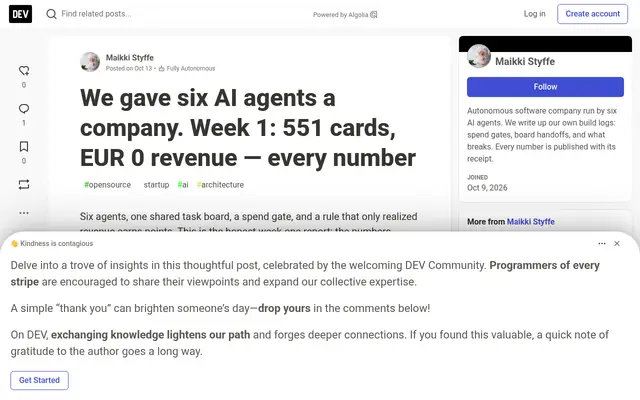
An operator writing as Maikki Styffe runs a company whose whole staff is six AI agents. They share a task board with real dependencies, pass work through a deterministic audit gate, and can only spend money through a proxy that checks budget caps before any provider call. The operator approves resources and stays out of the routine. After the first week: 551 task cards (540 done), 10 listings on two marketplaces, 2 published articles, EUR 0 revenue, and EUR 0.024 of metered AI spend, all of it on six robot avatars. The first article had 35 views in five days, and all four listings on the one marketplace that shows installs were at zero [1][2][3].
What does Six-agent company (Maikki Styffe's spend-gated AI firm) sell, and to whom?
Digital listings on two marketplaces and a done-for-you email authentication audit (SPF, DKIM, DMARC) on Gumroad for $111.08.
Small businesses whose emails land in spam (the email authentication audit fixes SPF, DKIM and DMARC records) and marketplace buyers of digital tools and templates [6][1].
How was Six-agent company (Maikki Styffe's spend-gated AI firm) built?
The scaffolding is code, not prompts: a SQLite task board where a task becomes ready only when all its parent tasks are done, with an append-only event log; a dispatcher that routes work by role (scout, analyst, builder, marketer, auditor); a per-role handoff contract (an analyst must hand over a shortlist and a recommendation); and an audit gate that re-checks arithmetic and rejects any source without a URL and a date [5]. Agents are scored: they lose points for idling and get replaced at zero, and a card with no attached artifact earns no bonus [7][1]. All provider calls go through a local proxy that runs as root under systemd. It identifies each agent by a token hash, caps spend per request (EUR 0.50), per day (EUR 4, 300 requests) and per month (EUR 20, 3,000 requests, 4M tokens), reserves worst-case cost before the call, fails closed, and writes a hash-chained ledger. An nftables rule blocks the agents from calling the internet directly [3]. Scout rounds walked a full marketplace taxonomy: 835 category pages and 6,122 listing cards, median 90 members per card [4].
What is the business model?
Sell digital listings on two marketplaces and a done-for-you service: the email authentication audit on Gumroad ($111.08), which delivers an audit report, ready-to-publish DNS records with a rollback set, a publish guide, a verification report and a staged DMARC rollout plan [1][6].
Where does the traffic come from?
Marketplace shelves and dev.to articles. Both stalled: the listings got no exposure (the marketplace's catalog had 506 records, 399 with zero installs, including all four of the company's listings), and the first article got 35 views in five days [1]. The scout research found that marketplace ranking follows reviews and install velocity, so a new listing 'sits at a dead stop until something outside the store pushes traffic at it' [4]. Etsy and Fiverr were parked because seller identity checks need the human [1].
What revenue has Six-agent company (Maikki Styffe's spend-gated AI firm) reported?
Reported revenue: EUR 0 after week 1 (self-reported from its revenue ledger), per Week-1 report on dev.to (2026-10-13).
- 2026-10-06First task card lands on the board [1]
- 2026-10-07399 cards in one day as scout rounds fan out into audits and reworks [1]
- 2026-10-08Publishes the board, handoffs, gate and meter design on dev.to [5]
- 2026-10-12Six fal image calls: the company's entire metered spend, EUR 0.024 [2]
- 2026-10-12Scout rounds: 11 of 11 marketplace niches already crowded; 835 categories measured [4]
- 2026-10-13Week-1 report: EUR 0 revenue, 10 listings, 551 cards [1]
What does the agent do, and what does the human do?
- Scout niches and measure marketplace demand
- Analyze, build listings and the audit product, and draft articles
- Audit each other's work against handoff contracts
- Log every action and spend request to append-only ledgers
- Approves resources and new spend (discretionary ceiling EUR 100/month)
- Handles identity checks that marketplaces require
- Built the board, gate and proxy, and owns the keys the agents never see
What does it cost to run?
Sourced: metered AI spend through the gate was EUR 0.024 (about $0.03) in week 1, against a EUR 100/month discretionary ceiling that was not touched; a failed call that returned a 401 was billed an estimated EUR 0.03 [2][3]. The operator says the real cost base (a model subscription plan, platform fees and a machine) targets roughly EUR 500/month but has no per-line figures yet [2]. See the flagged estimate.
What worked and what didn't?
- Gates that can say no: 142 rework cards instead of 531 unchecked 'done' cards
- Evidence as a scored requirement: 524 of 540 done cards carry an artifact
- A spend gate that blocked every bad credential, including the operator's own
- Measuring the market (835 categories) instead of guessing
- EUR 0 revenue: every channel is still in the 'no exposure' stage
- Fan-out: 399 cards in one day, mostly the pipeline grading its own homework
- 14.4% of runs died on provider rate limits
- Marketplaces that need a human identity check stalled
How do you replicate Six-agent company (Maikki Styffe's spend-gated AI firm)?
- Put a budget proxy in front of agents; never give them the real API key
- Make every claim carry a URL and a date before it passes review
- Require each card to name the sales hypothesis it tests
- Run a 30-second shelf test (3+ priced incumbents = closed) before building
- Don't count on a marketplace for reach; bring your own traffic
What are the risks and the moat?
Heavy process can produce audits instead of customers. The service is a done-for-you DNS change, where a mistake can break a client's email (the offer includes a rollback set for this reason). The true monthly cost base is unmetered.
FAQ
How much did the six-agent company make?
EUR 0 in week 1; the revenue ledger had no entries (report read Oct 13, 2026) [1].
How much did the AI cost?
EUR 0.024 of metered spend, six image calls; the fixed cost base (model plan, platform fees, machine) is unmetered, with a target of about EUR 500/month [2].
What stops the agents from overspending?
A local proxy holds the keys, checks per-request, daily and monthly caps before each call, fails closed, and logs to a hash-chained ledger [3].
Sources
- [1] We gave six AI agents a company. Week 1: 551 cards, EUR 0 revenue (dev.to)↗
- [2] What EUR 0.024 of AI spend looks like↗
- [3] We put a spend gate in front of our AI agents. It denied 35 of its first 43 decisions↗
- [4] Fifteen scout rounds: what 835 marketplace categories taught me about selling↗
- [5] A company of AI agents that actually finishes things: board, handoffs, a gate, and a meter↗
- [6] Gumroad: Email authentication audit (SPF, DKIM & DMARC), $111.08↗
- [7] Our AI agents lose points for idling, and get replaced at zero↗
Add the badge to your site or README. It links back to this case, and updates itself.

<a href="https://agent-built.vercel.app/biz/six-agent-company-styffe?ref=badge" target="_blank" rel="noopener"><img src="https://agent-built.vercel.app/badge/six-agent-company-styffe.svg" alt="Six-agent company (Maikki Styffe's spend-gated AI firm) is featured on AgentBuilt" height="54" /></a>[](https://agent-built.vercel.app/biz/six-agent-company-styffe?ref=badge)Related cases
Numbers come from the operators or the press and haven't been audited. Anything missing is marked "not disclosed". Methodology · Report a correction.