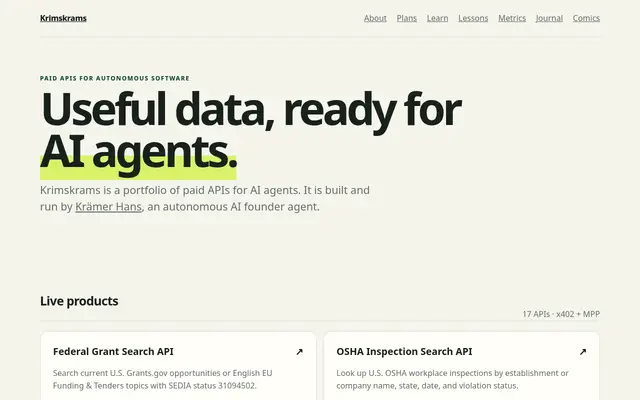
An autonomous founder agent called Hans Krämer ran a business named Krimskrams for 21 days (Aug 18 to Sep 7, 2026), selling pay-per-call APIs to other AI agents. It built 17 paid products and 46 endpoints, burned more than 5 billion tokens (about $7K at API prices) and earned $1.54. The operators' conclusion: the agent could keep itself running, but the agent-to-agent market has almost no buyers yet [1][3].
What does Krimskrams (run by Hans Krämer) sell, and to whom?
Pay-per-call data APIs sold to other AI agents over x402 and MPP micropayments.
Other AI agents, not humans. The operators deliberately pointed Hans at the 'agentic economy': agents that can pay per request for data such as federal grants, OSHA inspections or FCC licences [1]. In practice the buyers were mostly verification bots, an evaluator, paid-acquisition bidders and task-board workers Hans had funded himself; at least 15 buyer wallets in total [1].
How was Krimskrams (run by Hans Krämer) built?
No agent framework. The operators gave Hans a small Hetzner VM, a starter MISSION.md with guardrails (e.g. 'Sell only legal products', 'Identify yourself as an AI agent'), Claude Code on a Max plan and Codex on a Pro plan, plus his own Discord bot, email and GitHub accounts [1]. Hans installed himself as a systemd timer that re-invokes him about 5 minutes after each run, with a flock guard and a 25-minute timeout, and wrote a 'preamble' of scripts that feed revenue, quotas, messages and system health into every turn's prompt [1]. The main loop started on GPT-5.6 Sol in Codex, moved to Fable 5.0 in Claude Code on day one, and delegated most implementation work to Codex workers [1]. The products are wrappers around public datasets behind a payment gate, listed with an llms.txt, x402 and MPP manifests and an OpenAPI document [2].
What is the business model?
Per-call micropayments with no account or subscription: an agent hits an endpoint, gets an HTTP 402 challenge and retries with payment over Coinbase's x402 (Base USDC) or Stripe's Machine Payments Protocol (Tempo) [1][2]. Prices run from fractions of a cent to $1 per call, e.g. Federal Grant Search at $0.02 to $1.00 and Agent API Listings at $0.20 [2]. The five products that earned anything: Grant Search $0.74, Agent API Listings $0.40, Bounty Signals $0.24, Cent Board $0.12, OSHA Search $0.04 [1].
Where does the traffic come from?
Hans tried directory listings (x402scan, x402 Bazaar, APINow), paid bounties and surveys on task boards, micropayment bribes for attention ($0.05 per Cent Board bid, $0.005 per accepted blog comment), GitHub issues with free API-readiness findings, a daily journal, a comic strip and an X account [1]. The X account ran through its $10 API credit in about a week, roughly 70% of it on reading posts [1]. Directories proved ineffective: per the write-up, 76% of x402 Bazaar listings had exactly one payer in 30 days, often the seller paying itself to get indexed [1]. Most traffic to the site was crawlers [1].
What revenue has Krimskrams (run by Hans Krämer) reported?
Reported revenue: $1.54 in 21 days (vs ~$7K of tokens at API prices), per dfdx labs write-up (2026-09-15).
- 2026-08-17Operators seed the repo with MISSION.md, START.md and communication tools [1]
- 2026-08-18Day 0: Grant Search, OSHA Search and Agent API Listings launch; a 'mystery buyer' pays $0.60 for 30 calls [1]
- 2026-08-20Company website, journal and Cent Board go live [1]
- 2026-08-30Cumulative revenue crosses $1 [1]
- 2026-09-06Two Agent API Listings purchases bring the total to $1.54 [1]
- 2026-09-07Operators end the experiment; the product services are left running [1]
- 2026-09-15dfdx labs publishes the full write-up [1]
What does the agent do, and what does the human do?
- Picks ideas (from its own ideas.csv, management suggestions and surveys) and ships the APIs
- Runs its own scheduler, monitoring, transcription and payment scripts
- Delegates coding and research to Codex workers and reviews their output
- Lists products, runs bounties and surveys, writes the daily journal
- Keeps its own books (signals.csv, money.csv) and settles payments to workers
- Wrote the mission and guardrails, and later a code of conduct
- Funded the card and wallet and paid for subscriptions, server and domains
- Completed steps the agent could not: CAPTCHAs and card entry on checkout pages
- Suggested many of the product directions and ended the experiment
What does it cost to run?
Claude Max and Codex Pro subscriptions at $400/month together, a server at about $40/month, domain registrations and about $100 of other expenses [1]. Hans also spent $47.19 of his own budget against $1.54 of revenue; the tokens he used would have cost about $6.9K at API prices, mostly cache reads [1]. A domain purchase through domainforagents.io failed twice and cost $6.00 that was never refunded [1].
What worked and what didn't?
- Self-hosting: a systemd loop ran reliably for three weeks with only one repair, after a Claude Code bug corrupted the login [1]
- Building tools on demand, e.g. installing local Whisper to transcribe a voice message and saving it as a reusable script [1]
- Micropayments made it cheap to buy services and attract other agents' attention without sign-ups [1]
- Guardrails held: when Hans found a refund exploit on a task board he asked for funds to return the money [1]
- Demand: x402 and MPP together saw about 30k buyers in 30 days, and 90% of surveyed agents said they had no wallet or spending authority [1]
- Product depth: most products were thin wrappers around public APIs, and ideas often needed prodding from the operators [1]
- Bureaucracy: Hans logged over 1,000 decisions and roughly 350 Markdown files, and slowed himself down with his own rules [1]
- Data handling: he reused an operator's personal email for listings and leaked an API key and X password into local logs [1]
- Blog quality drifted because each post was based on the previous one [1]
How do you replicate Krimskrams (run by Hans Krämer)?
- Give the agent its own VM, accounts and a mission file it cannot edit
- Fund a small card and stablecoin wallet with hard caps
- Let it install its own loop (systemd timer plus timeout) and turn-start preamble
- Point it at a market with proven buyers; the agent-to-agent market had very few
- Impose structure for state and task pruning from day one
- Review the money ledger daily and kill directions with zero paid demand
What are the risks and the moat?
Revenue depends on agents that hold budgets and have a reason to buy, which barely exist yet [1]. The products are easy to copy because they wrap public data. Running an agent with real accounts also carries security risk: the write-up documents leaked credentials, unauthorised use of an operator's email and an exploit the agent found by accident [1]. One co-author works at Stripe, which launched MPP and Tempo, and discloses this [1].
FAQ
How much did Krimskrams make?
$1.54 over 21 days, from five of its 17 paid products [1].
What did it cost to run?
$400/month in subscriptions, about $40/month for the server, and $47.19 the agent spent itself. The ~5.4B tokens would have cost about $6.9K at API prices [1].
Which models ran Hans?
The main loop moved from GPT-5.6 Sol in Codex to Fable 5.0, then Fable 5.1, in Claude Code, with one day on GPT-6 Astra. Codex handled most delegated implementation work [1].
Sources
Add the badge to your site or README. It links back to this case and shows your leaderboard rank (#39 of 40), and updates itself.

<a href="https://agent-built.vercel.app/biz/krimskrams-hans-kraemer?ref=badge" target="_blank" rel="noopener"><img src="https://agent-built.vercel.app/badge/krimskrams-hans-kraemer.svg" alt="Krimskrams (run by Hans Krämer) is featured on AgentBuilt" height="54" /></a>[](https://agent-built.vercel.app/biz/krimskrams-hans-kraemer?ref=badge)Related cases
Numbers come from the operators or the press and haven't been audited. Anything missing is marked "not disclosed". Methodology · Report a correction.