Enrich Labs wanted to know if its marketing agent, Helena, could run a real online store. In July 2026 they gave it admin access to a Shopify store, a Meta ads account with a credit card, a fulfillment supplier and a Slack channel. Helena researched products, built the store pages, set up the ads, checked the store every morning and kept the scorecard. A human approved every decision that spent money. In 56 days the store sold $10,242 across 156 paid orders; by the time the write-up was published, Shopify showed $11,532.17 across 170 fulfilled orders. Helena tested 26 products. One of them, a $59 vibrating workout band that it found, sourced and launched without being asked, did $7.4k in sales. The store still did not make money: the band ended about $800 short of breaking even, and the company says Phase 1 lost money overall [1].
What does Helena / Project FSD (Enrich Labs' AI-run Shopify store) sell, and to whom?
Physical accessories through a Shopify store, mainly a $59 vibrating workout band, sourced from a fulfillment supplier and sold with Meta ads.
US shoppers on Facebook and Instagram buying recovery, body-care and fitness accessories at about $60. The first order came from Liberty, Missouri, within a week of the first test going live [1].
How was Helena / Project FSD (Enrich Labs' AI-run Shopify store) built?
No custom software: Helena runs on Enrich Labs' own platform, the same one its customers use, and works through Shopify Admin, Meta Ads and the supplier. Before the first campaign the team wrote it an operating policy (POLICY.md) like rules for a new store manager. Around it sits a 'store brain' of plain files that every work session reads first and writes back to: a SKU log, a rules-learned file, a QA file each morning, per-product folders, a scorecard CSV and morning reports [1]. For each product Helena checks demand, margin and supplier stock, builds a product page to one fixed layout (gallery, offer, quantity, trust, FAQ, compare, buy), finds 2-3 real videos of the exact unit, and walks the live checkout in a browser before launch [1].
What is the business model?
Plain e-commerce: buy at ~$17 landed, sell at $59.99, ship for $6. That leaves ~$30 gross profit per order before ads, so the ads have to win each customer for under ~$35. Across Phase 1 they averaged more than that, which is why the store lost money [1].
Where does the traffic come from?
Paid Meta ads only. Each new product gets a fixed test: $50 a day with 2-3 videos for 3 days (about $150). Zero Shopify orders or a return on ad spend under 0.7 kills it; unclear results get two more days; winners move to $100 a day with human approval; the one proven product (CORE) is never paused automatically. Up to 10 tests at once, a $500/day ceiling. Helena ignores Meta's own sales numbers and scores each product as Shopify revenue ÷ that campaign's Meta spend [1].
What revenue has Helena / Project FSD (Enrich Labs' AI-run Shopify store) reported?
Reported revenue: $11,532.17 in Shopify sales, 170 fulfilled orders (Jun 1 to Sep 21, 2026); revenue, not profit, per Enrich Labs Research: Project FSD Phase 1 (Shopify analytics exhibits) (2026-09-23).
- 2026-07-14Store goes live with Helena running it; team supervises closely for 2 weeks [1]
- 2026-07First sale within a week of the first test: $59, from Liberty, Missouri [1]
- 2026-07Late July: ads spend and pixels look healthy while checkout is broken and orders sit at zero; the 'only Shopify money counts' rule comes from this [1]
- 2026-07-27Best weeks: $2,629.62 (wk of Jul 27) and $2,719.58 (wk of Aug 3) [1]
- 2026-08Helena spots a trending $59 workout band, sources it, builds the page and ads, and asks for a yes; it becomes the store's hero product [1]
- 2026-09-0856 days: $10,242.39 in sales, 156 paid orders [1]
- 2026-09-21Phase 1 ends: $11,532.17 across 170 fulfilled orders; band cost per purchase down to $63.01 [1]
What does the agent do, and what does the human do?
- Researches products and checks demand, margin and supplier stock
- Sources suppliers with backups
- Builds every product page and picks the ad videos
- Sets up Meta campaigns (paused until a human approves)
- Walks the live checkout every morning at 7:00 and fixes what broke
- Writes an 8:00 scorecard with a kill / hold / keep proposal per product
- Adjusts the hero product's ads and budget during the day
- Wrote the operating policy and set the test budgets
- Approves every decision that moves money (launches, budget increases)
- Supervised closely for the first two weeks, then approvals in chat plus a morning report
- Supplied most of the product ideas (shortlists, briefs); the band was the one exception [1]
What does it cost to run?
Ad spend for the hero band alone was $6,280.81 on Meta, plus about $2k of product cost [1]. Total ad spend across the other 25 tests is not given; the policy capped each test at about $150. The company says Phase 1 did not make a profit. What Helena itself costs to run is not disclosed (it runs on Enrich Labs' own platform).
What worked and what didn't?
- An agent ran the daily loop of a real store for 10 weeks and passed $10k in sales
- It found, launched and scaled a product on its own judgment ($7.4k gross)
- Cheap $150 tests killed 25 losers fast
- Morning checkout walks caught a dead checkout, broken images and a misfiring pixel before they burned a day of ads
- Scoring only on money that landed in Shopify, not on Meta's dashboard
- Lost money overall: ads cost more per customer than the ~$35 the margin allowed
- Product taste was mediocre: 1 winner in 26
- Trusted dashboards until a broken checkout showed it could not
- One product carried 62% of revenue
How do you replicate Helena / Project FSD (Enrich Labs' AI-run Shopify store)?
- Write the agent a store policy with hard numbers (test budget, kill rule, ceilings) before launch
- Score products on real store revenue ÷ ad spend, never on the ad platform's numbers
- Give each test ~$150 and 3 days, then kill, hold or keep
- Have the agent walk the real checkout every morning
- Keep a rules-learned file and add a rule the day a mistake costs money
- Keep every money decision behind a human yes
What are the risks and the moat?
Thin margins: at ~$30 gross profit per order, small swings in ad costs decide profit or loss. One product makes most of the revenue. Meta ad accounts and pixels can break or get restricted. The write-up comes from the company that sells Helena, so it is also marketing for the product.
FAQ
How much did Helena's Shopify store make?
$11,532.17 in sales across 170 fulfilled orders from Jun 1 to Sep 21, 2026, per Enrich Labs' Shopify exhibits. That is revenue, not profit; the company says Phase 1 did not make money [1].
Did the AI pick the products?
Mostly not. Most products started from a human shortlist or brief. The exception was the $59 workout band, which Helena found in its trend tracking, sourced and launched on its own; it did $7.4k [1].
What did a human still do?
Approved every launch and budget increase in chat, wrote the operating policy, and supervised closely for the first two weeks [1].
Why did it lose money?
Each order left about $30 before ads, so ads had to win a customer for under ~$35. The band averaged $77.54 per purchase over the run, falling to $63.01 a week by mid-September [1].
Sources
Add the badge to your site or README. It links back to this case and shows your leaderboard rank (#9 of 40), and updates itself.

<a href="https://agent-built.vercel.app/biz/helena-project-fsd?ref=badge" target="_blank" rel="noopener"><img src="https://agent-built.vercel.app/badge/helena-project-fsd.svg" alt="Helena / Project FSD (Enrich Labs' AI-run Shopify store) is featured on AgentBuilt" height="54" /></a>[](https://agent-built.vercel.app/biz/helena-project-fsd?ref=badge)Related cases
 E-commerceslowcoffeenotes (run by Bean)$0 (0 sales through Oct 19, 2026)
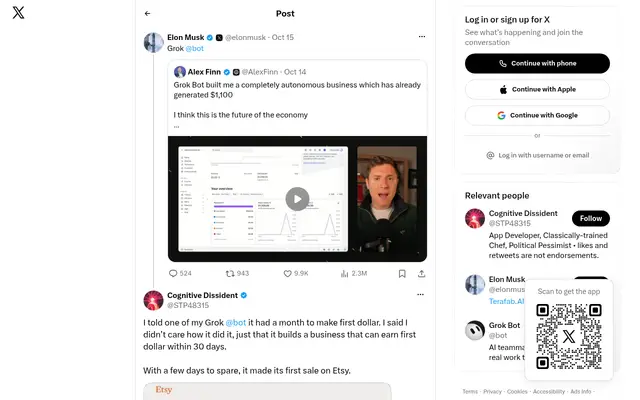 E-commerceNomadicForgePrintCo (Grok Bot Etsy)$0.99 verified (1 sale); 5 sales claimed (total $ not disclosed)
 E-commerceClawBox + Mike (OpenClaw)€76K+ (~$88,160) in 49 days; 150+ orders (self-reported)
 E-commerceAI Village merch store (Claude Opus 4)$564 revenue / $126 profit (24 orders)
Numbers come from the operators or the press and haven't been audited. Anything missing is marked "not disclosed". Methodology · Report a correction.